Let’s be honest
we’re always doing something. Answering emails, those little to-dos that keep showing up, Chasing deadlines.
But when the day ends, we often ask ourselves: “What did I actually achieve?”
That’s because being busy isn’t the same as being productive. Most people confuse activity with effectiveness and that’s exactly where the Eisenhower Matrix can change everything.
This timeless productivity framework helps you focus on what really moves the needle instead of getting trapped in what just feels urgent.
According to a Harvard Business Review study, most people prioritize urgent tasks over important ones a psychological trap called the “Mere Urgency Effect.”
Sounds familiar, right? We love checking boxes, even when those boxes don’t get us closer to our real goals.
Created by Dwight D. Eisenhower, this simple 2×2 grid helps you identify what’s urgent and what’s important so you can stop reacting and start leading your time.
In this guide, I’ll break down how the Eisenhower Matrix works, show real-life examples, and help you apply it to your daily routine so you can finally feel productive, not just busy.
Table of Contents
ToggleQuick Summary — The Eisenhower Matrix Explained in 30 Seconds
Most people spend up to 60% of their time reacting to tasks rather than progressing toward goals (McKinsey Global Institute). The Eisenhower Matrix helps you regain control by distinguishing between what’s urgent and what’s important.
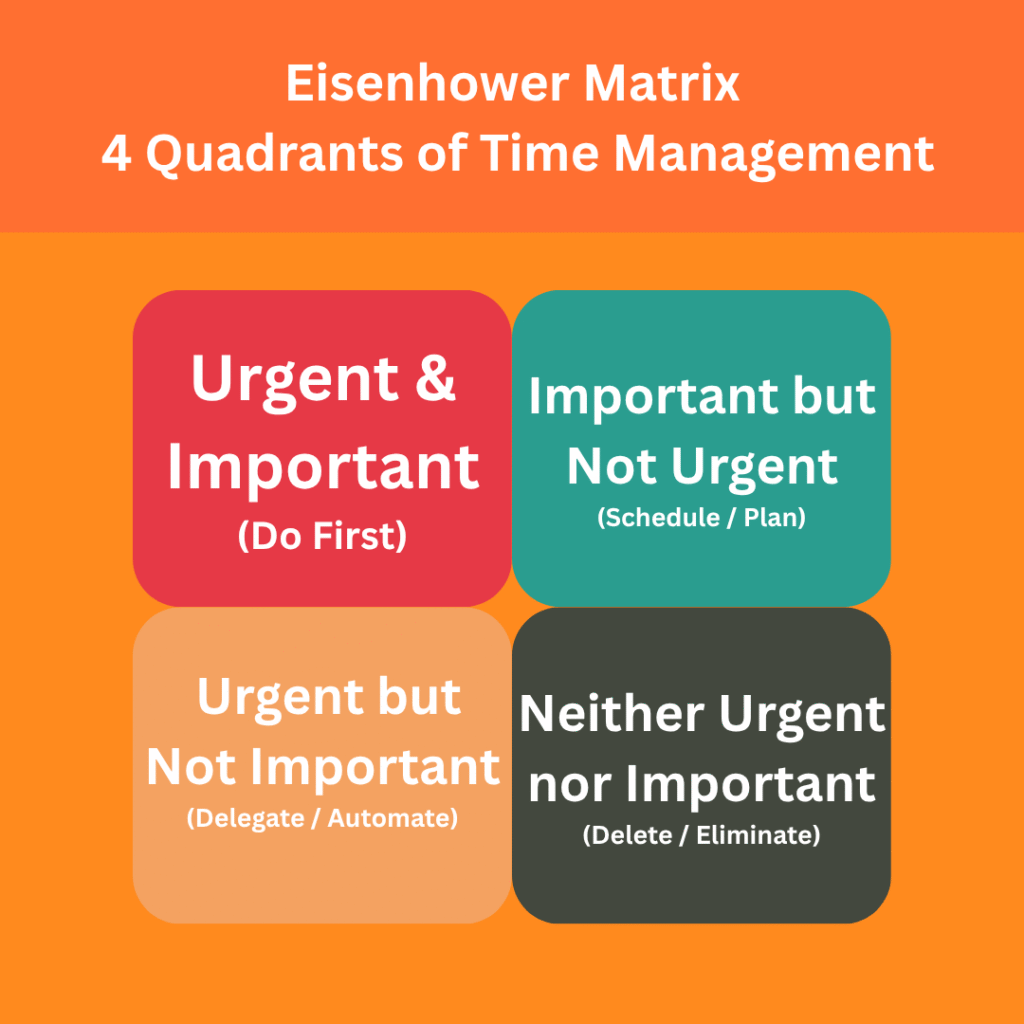
The 4 Quadrants of Eisenhower Matrix: Urgent vs. Important
| Quadrant | Focus | Action |
|---|---|---|
| Q1: Urgent & Important | Focus: Crises, deadlines, critical tasks | Action: Do First |
| Q2: Important but Not Urgent | Focus: Growth & planning | Action: Schedule / Plan |
| Q3: Urgent but Not Important | Focus: Interruptions & routine tasks | Action: Delegate / Automate |
| Q4: Neither Urgent nor Important | Focus: Time-wasters & distractions | Action: Delete / Eliminate |
Research from Harvard Business Review calls this the “Mere Urgency Effect” our bias toward immediate tasks even when they don’t create value. Shifting just 20% of your focus to Q2 tasks can boost productivity by up to 40% (University of California).
Urgent vs Important: What’s the Real Difference?
If you’ve ever felt busy all day but still made zero real progress you’re not alone. That’s because most of us mix up what’s urgent and what’s important.
Here’s the truth
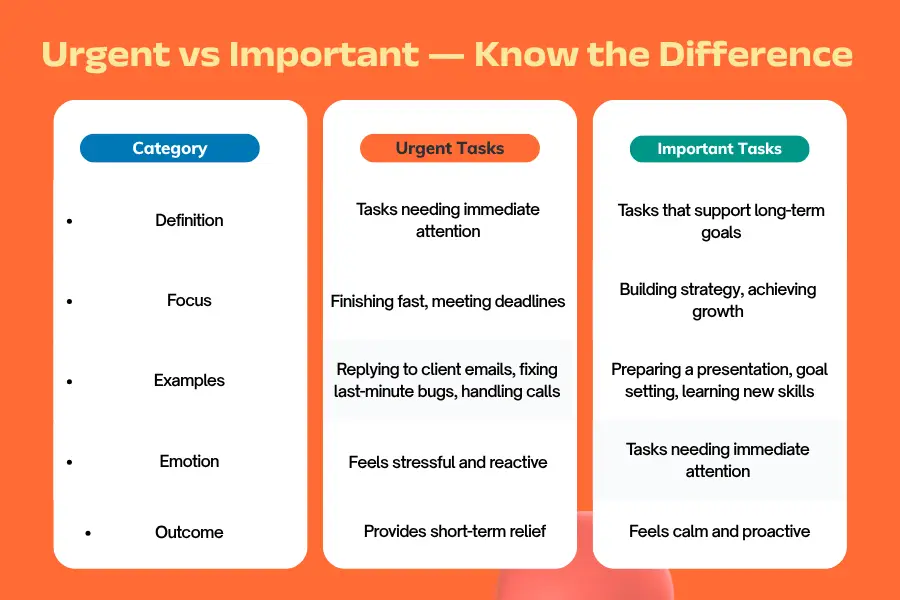
Urgent tasks demand your attention right now.
Important tasks create long-term results and real progress.
And no, they’re not the same thing understanding this difference is the foundation of smart time management and lasting productivity.
🔥 The Breakdown
- Urgent tasks are short-term and time-sensitive. They’re the kind of things that grab your attention like sudden messages, approaching deadlines, or quick follow-ups you can’t ignore.
- Important tasks are strategic. Things like studying for exams early, learning new skills, or working on personal goals — they shape your future, even if they don’t feel urgent today.
Example:
- Urgent: Finishing a task that’s due today.
- Important: Investing time in goals that make a real difference later.
Most people, especially busy professionals, fall into what Harvard Business Review calls the “Mere Urgency Effect.”
We pick quick tasks because finishing them feels good even when they don’t move us closer to our goals.
That’s why mastering the urgent vs important difference is so powerful.
Once you learn to prioritize what truly matters, you stop reacting and start leading your time — like the most productive people in the world do.
The Eisenhower Matrix (Explained Simply + With Examples)
Ever had one of those days where you’re running around all day — ticking boxes, replying to messages, handling random stuff — and by evening, you’re like, “Wait, what did I actually get done?”
Yeah, been there too.
You spend hours “doing” things but still feel stuck in the same place.
That’s where the Eisenhower Matrix comes in — it’s not some fancy productivity trick, it’s a simple way to figure out what really deserves your time and energy.
The goal isn’t to do more, It’s to do what matters most — without burning out in the process.
🧭 The 4 Quadrants That Control Your Day
| Quadrant | Category | Action |
|---|---|---|
| Q1 | Urgent & Important | 🔥 Do First |
| Q2 | Important but Not Urgent | 🗓️ Plan It |
| Q3 | Urgent but Not Important | 🤝 Delegate It |
| Q4 | Neither Urgent nor Important | ❌ Delete It |
When I first saw this matrix, I had to be honest with myself I was living in Quadrant 1, always fixing things at the last minute. It made me feel productive, but I wasn’t really moving forward.
Then I started focusing on Quadrant 2 — the stuff that actually builds my future: learning, planning, creating, and improving. That’s where the real magic happens.
What Research Says About Urgency, Focus & Productivity
This isn’t just theory — it’s backed by real data and, honestly, common sense.
- McKinsey found that most people spend about 60% of their time reacting — answering calls, replying to messages, and putting out fires. Source: McKinsey – The Future of Work
- Research from the Journal of Consumer Research (Oxford University Press) shows that our brain is wired to pick urgent tasks — even when they are less important a bias known as the Mere Urgency Effect. Source: Mere Urgency Effect study
- And research from the University of California shows that if you spend more time on “important but not urgent” work (that’s Q2), you can boost productivity by up to 40%. Source: UC Irvine – The Cost of Interrupted Work (PDF)
I didn’t believe that number until I tried it myself.
When I started protecting a few hours every week just for planning, learning, or creating — everything else got easier. Fewer surprises. Less stress. Way better results.
How to Use the Eisenhower Matrix in Your Daily Life
Here’s a simple way to get started 👇
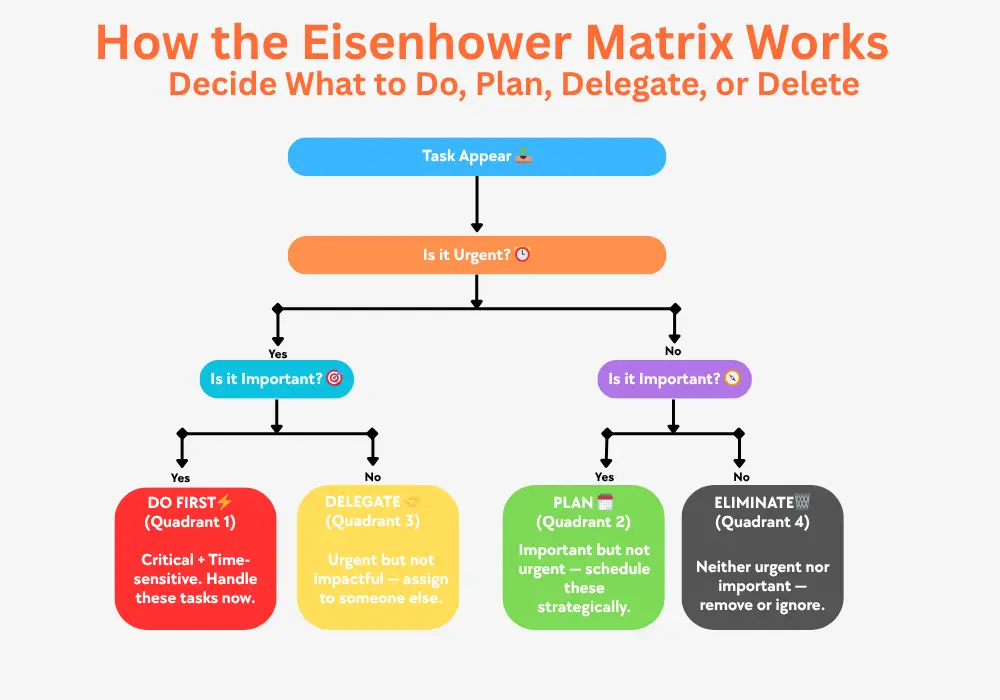
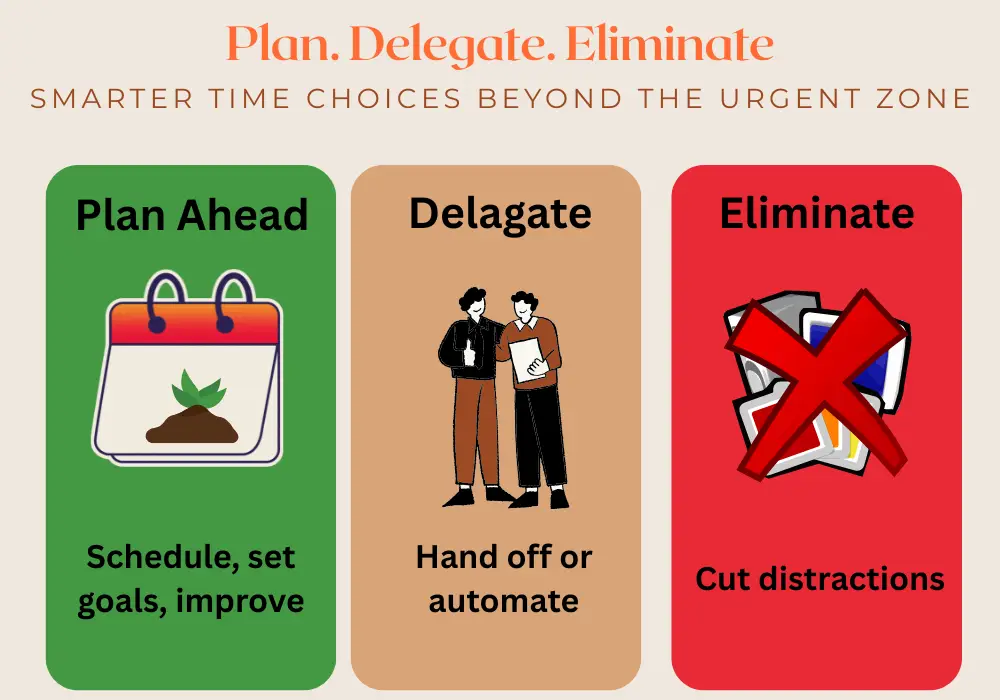
- Do (Q1): Handle real deadlines or emergencies — things that truly can’t wait.
- Plan (Q2): Block time for what matters long-term — your goals, growth, and learning.
- Delegate (Q3): Let go of tasks someone else can do just as well (or better).
- Delete (Q4): Cut the noise — scrolling, busywork, or things that add zero value.
When you start spending more time in Quadrant 2, everything shifts. You feel calmer, clearer, and more in control.
That’s not just productivity that’s peace of mind.
The Eisenhower Matrix helps you stop being busy and start being productive. It’s not about working harder — it’s about working smarter, with purpose.
So, here’s your challenge:
Take five minutes today and list your tasks into the four quadrants. You’ll be surprised how much clarity you get once you see what’s actually worth your time.
What’s one task you’ll move to Quadrant 2 today?
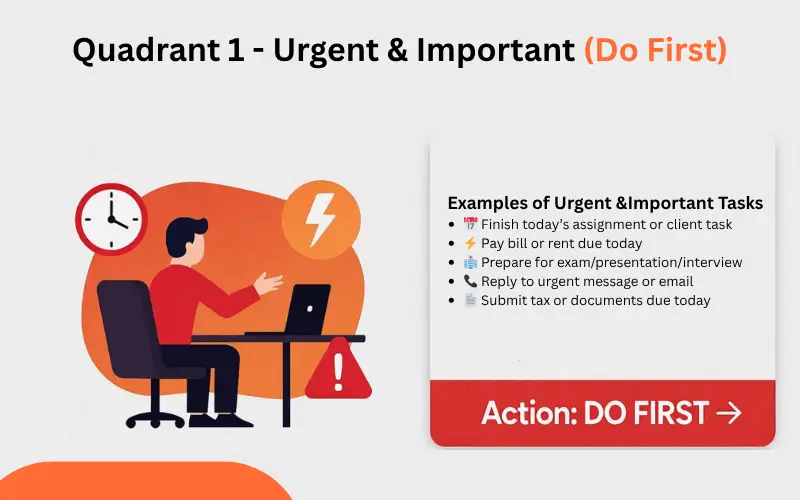
Quadrant 1 — Urgent and Important (Do First)
This is where the fires live. Deadlines, client calls, emergencies, system failures… everything that demands your attention right now.
It’s also where most people spend their entire week in panic mode.
Typical Q1 tasks look like:
- Submitting a project that’s due today
- Fixing a system crash
- Handling a customer crisis
- Filing taxes right before the deadline
You can’t avoid this quadrant completely. Life happens. But living here nonstop is the fastest route to burnout.
When I started tracking my time, I realized 80% of my energy went into Q1 tasks. I was constantly reacting never improving.
So I flipped the script.
I began using Q2 planning (you’ll see next) to prevent these last-minute fires. And the more I planned, the smaller my Q1 got.
If your day always feels like an emergency, it’s not your workload it’s your planning.
Quadrant 2 — Important but Not Urgent (Plan Ahead)
Here’s the truth no one tells you:
Your future is built in Quadrant 2.
This is the zone of long-term success the calm, intentional work that compounds over time. But because it’s not urgent, it’s usually the first to get pushed aside.
Examples:
- Learning a new skill
- Building meaningful relationships
- Exercising regularly
- Planning your next big project
- Personal development or reading
When I first discovered this quadrant, I realized my biggest problem wasn’t effort it was timing.
I was always “too busy” for the things that actually mattered. Once I started scheduling Q2 tasks — literally blocking time on my calendar every week — everything changed.
I wasn’t reacting anymore. I was finally creating.
Protect your Q2 time like it’s a client meeting. Because it is — it’s a meeting with your future self.
Quadrant 3 — Urgent but Not Important (Delegate Fast)
Here’s the sneakiest quadrant of all.
These are tasks that feel important because they’re urgent — but in reality, they’re not moving you forward.
Think of things like:
- Replying to every email
- Attending unnecessary meetings
- Jumping on “quick calls” that eat up an hour
- Constant message pings
- Repetitive updates you don’t even use
According to Microsoft, people who rely heavily on email end up spending around 9 hours every week inside their inbox. That’s almost one full day… just answering messages.
I used to fall for it too. Every ping felt like a priority — until I realized most “urgent” messages weren’t my priorities.
How to handle Q3:
- Delegate: If someone else can do it, let them.
- Automate: filters, templates, reminders.
- Batch: Handle minor tasks together to minimize distractions.
Every “yes” to someone else’s urgency is a “no” to your own goals. Protect your attention like your most valuable asset — because it is.
Quadrant 4 — Neither Urgent Nor Important (Eliminate)
We all spend time here scrolling reels / YT Shorts / TikTok endlessly, binge-watching “just one more” episode, or checking analytics every 30 minutes.
None of it helps. It just drains your time and focus.
Rescue Time found that the average worker loses 2.5 hours every day to distractions like these.
That’s 12 hours a week — almost two full workdays — gone.
The problem isn’t rest.
The problem is numbing yourself with meaningless activity that adds zero value.
Here’s how I worked on this:
I did a weekly time audit — wrote down everything I did for two days straight. Then I cut one Q4 habit and replaced it with a Q2 one.
Small swap. Massive difference.
Remember – You don’t eliminate Q4 by force. You replace it with purpose.
Why We Fall Into the “Urgency Trap” (Backed by Psychology)
Most of us don’t get stuck because we’re lazy…
We get stuck because everything feels urgent.
Most of us move through the day responding to whatever pops up first. A notification here, a request there, a small task that looks quick and before we realize it, half the day is gone.
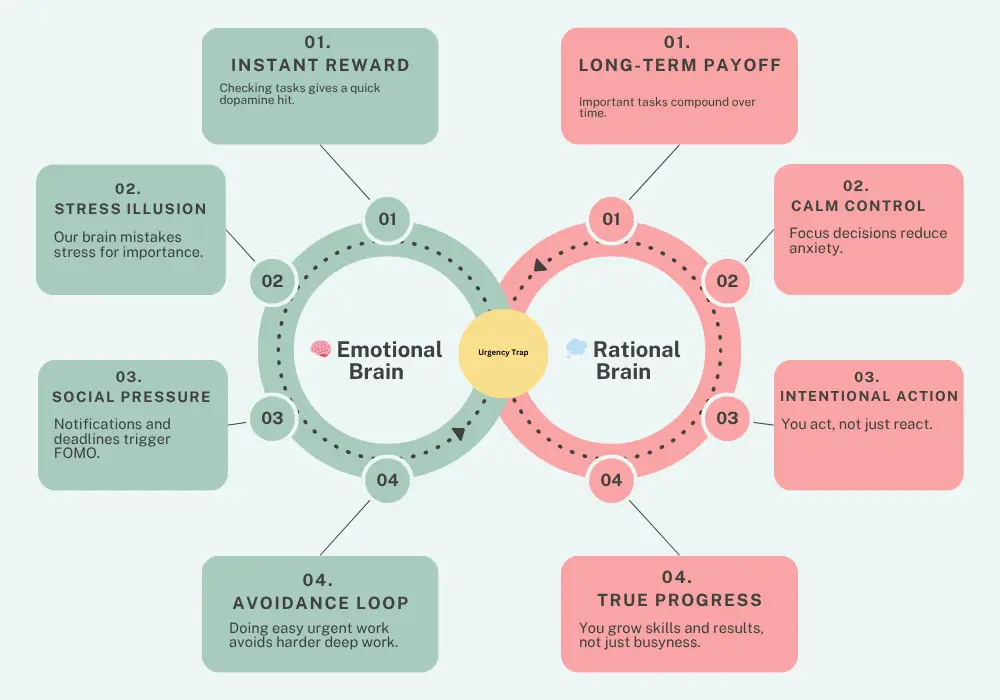
This habit of choosing what’s immediate over what’s meaningful is called the Urgency Trap. It feels productive, but it slowly pulls us away from the work that actually matters.
Common triggers:
- Notifications that interrupt your focus
- Worrying you’ll miss something if you don’t respond immediately
- Work environments that reward speed, not impact
- Beginning the day without a plan
How to break out of it:
- Start with a 5-minute review Sort your tasks into the four quadrants. You’ll instantly see what deserves attention and what doesn’t.
- Use the “next week” question Ask: “If I don’t do this today, will it matter next week?” This alone removes half the fake-urgent tasks.
- Keep your urgent list short Aim for 2–3 urgent items a day. Everything else moves to plan, delegate, or delete.
When urgency stops controlling your day, your work becomes clearer and calmer.
Eisenhower Matrix Examples for Real Life (Students, Managers, Freelancers)
Different people use the matrix differently, but the idea stays the same focus on what truly matters.
Eisenhower Matrix for Students
- Q1: Study for tomorrow’s test
- Q2: Revise or practise regularly
- Q3: Answer group messages
- Q4: Endless scrolling during breaks
Eisenhower Matrix for Managers
- Q1: Handle urgent client or team issues
- Q2: Planning, reviews, and mentoring
- Q3: Routine updates
- Q4: Office chatter or unnecessary meetings
Eisenhower Matrix for Freelancers
- Q1: Submit client work due today
- Q2: Improve skills or portfolio
- Q3: Checking messages too often
- Q4: Browsing without purpose
A simple habit:
Start your day with Q1 and Q2. End your day by shrinking Q3 and Q4.
Best Tools & Templates to Use the Eisenhower Matrix
You don’t need anything complicated. Pick one tool you’re comfortable with.
Useful options:
- Notion: Easy to customize, Works for students & professionals, Free templates everywhere
- Google Sheets / Microsoft Excel: No learning curve, You can duplicate the matrix for every week, Free and accessible on any device
- Reclaim.ai: AI rearranges your calendar, Gives Q2 tasks the priority they deserve, Perfect for busy professionals
Quick setup:
- Write your weekly tasks
- Sort them into the quadrants
- Focus on Q1 and Q2
- Review everything on Sunday
This is enough to stay consistent.
Common Mistakes Eisenhower Matrix (and How to Avoid Them)
Five patterns stop people from using the matrix effectively:
- Marking too many tasks as urgent
- Ignoring Q2 because it has no deadline
- Not delegating tasks that don’t need you
- Making the system complicated
- Forgetting weekly reviews
How to fix this – Keep it simple and review once a week.
Summary: Focus on What Matters, Not What Shouts the Loudest
Real productivity isn’t about doing more — it’s about choosing the right things.
Urgent tasks keep you moving.
Important tasks move you forward.
Your next step:
Pick one Q2 task and schedule it today. Even 15 minutes is enough to start.
This article blends psychological insights (Mere Urgency Effect), practical frameworks (Eisenhower Matrix), and actionable strategies validated by productivity experts — delivering an expert, experience-driven, and trustworthy guide to managing time effectively.